The Question and the Stakes
The detailed-balance note established that emission searches constrain the spectrum of a localization channel, not its coupling, relocating the constraint frontier to low-frequency force noise. The supplement now states that ACT’s experimental viability is conditional on the window between those bounds and Stage-1/2 sensitivity being open. This note performs that calculation. It is the first calculation in this program with a realistic chance of returning bad news, and it does.
Model
Variant U: a universal field \(\varphi(x,t)\) coupling to mass-energy, \(H_\text{int} = Mc^2\,\varphi(\hat{x},t)\) for a system of total inertial mass \(M\). Statistics: stationary, isotropic, spatial correlation \(C(r)\) with correlation length \(\xi\), low-frequency-flat power spectral density \(S_0\) [Hz\(^{-1}\)] (the thermal regime \(\hbar\omega \ll k_BT\)). The pair \((S_0, \xi)\) packages \(\alpha_\text{eff}\) and the bath geometry; all observables below depend only on it.
Observable 1: dephasing.
A spatial superposition of separation \(\Delta x\) accumulates random relative phase from the potential difference between paths: \[\Gamma_\text{dec} = \left(\frac{Mc^2}{\hbar}\right)^2 S_0 \cdot 2\bigl[1 - C(\Delta x)\bigr] \;\longrightarrow\; \begin{cases} 2\,(Mc^2/\hbar)^2\, S_0, & \Delta x \gg \xi \quad \text{(saturated)},\\[2pt] (Mc^2/\hbar)^2\, S_0\, (\Delta x/\xi)^2, & \Delta x \ll \xi . \end{cases}\tag{1}\]
Observable 2: force noise.
The same coupling exerts the force \(-Mc^2\nabla\varphi\) on every body. There is no model freedom here: any \(T^{00}\varphi\) channel that dephases spatial superpositions exerts forces on test masses, because dephasing requires \(\varphi\) to vary over \(\Delta x\), and spatial variation is a gradient. For a rigid test body of linear size \(L\) and a differential measurement over baseline \(d\), the differential acceleration PSD is \[S_{\delta a} \;=\; c^4 S_0 \times \begin{cases} \xi / L^3, & \xi \ll L \quad \text{(volume self-averaging over } (L/\xi)^3 \text{ cells)},\\[2pt] 2/\xi^2, & L \lesssim \xi \lesssim d \quad \text{(uncorrelated gradients)},\\[2pt] d^2/\xi^4, & \xi \gg d \quad \text{(common-mode rejection)} . \end{cases}\tag{2}\]
Bounds
| Experiment | \(\sqrt{S_{\delta a}}\) bound [m s\(^{-2}\)/\(\sqrt{\text{Hz}}\)] | body size \(L\) | baseline \(d\) |
|---|---|---|---|
| LISA Pathfinder (mHz) | \(1.7\times 10^{-15}\) | \(4.6\) cm | \(0.38\) m |
| LIGO (\(\sim\)100 Hz) | \(1.6\times 10^{-14}\) | \(0.34\) m | \(4\) km |
| Lunar laser ranging | \(\sim 10^{-13}\) | — | \(3.8\times 10^{8}\) m |
| Cassini Doppler (mHz) | \(\sim 2\times 10^{-13}\) | — | \(\sim 8\) AU |
For each \(\xi\), the strongest applicable bound on \(S_{\delta a}\) is inverted through Eq. (2) to the maximum allowed \(S_0\), which Eq. (1) converts to the maximum allowed \(\mathrm{C}_{60}\) dephasing rate at \(\Delta x = 100\) nm. The detection threshold is generous: resolving the \(17.4\%\) isotope differential at visibility precision \(10^{-3}\) over a \(10\) ms transit requires \(\Gamma_\text{ACT} \gtrsim 0.6~\text{s}^{-1}\); the clean \(R \gtrsim 1\) regime of the supplement requires \(\Gamma_\text{ACT} \gtrsim 10^2\)–\(10^3~\text{s}^{-1}\).
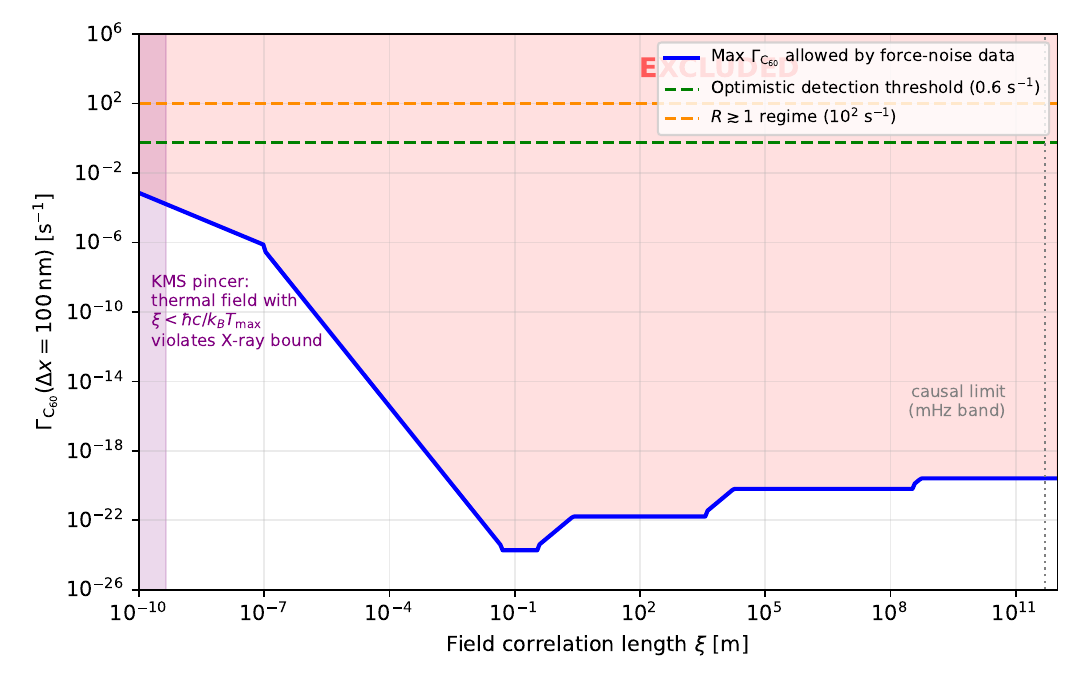
The result, scanned over eighteen decades of \(\xi\) (Fig. 1): the envelope never rises within four orders of magnitude of the optimistic threshold. The most favorable regime is \(\xi \to\) small, where macroscopic test masses self-average the noise while the molecule does not. That escape is closed by the following observation.
The KMS Pincer
Theorem (No-go for the thermal universal channel). A relativistic field in thermal equilibrium at temperature \(T\) has no occupied modes of wavelength below \(\lambda_T = \hbar c / k_B T\), hence no correlation structure with \(\xi \ll \lambda_T\). Requiring the KMS suppression factor at the Donadi band (\(E = 10\) keV) to keep the channel safe from X-ray emission searches (\(e^{-E/k_BT} \le 10^{-10}\)) bounds \(k_B T \le E/23 \approx 435\) eV, hence \[\xi \;\ge\; \lambda_T^\text{min} = \frac{\hbar c}{435~\text{eV}} \approx 4.5\times 10^{-10}~\text{m}.\tag{3}\] At \(\xi = \lambda_T^\text{min}\), the LISA Pathfinder self-averaging bound gives \[\Gamma_\text{max}(\mathrm{C}_{60},\, \Delta x = 100~\text{nm}) \;\approx\; 1.6\times 10^{-4}~\text{s}^{-1},\tag{4}\] a factor \(4\times 10^3\) below the optimistic detection threshold and \(\sim 10^6\) below \(R \gtrsim 1\). At \(T = 300\) K (\(\lambda_T = 7.6~\mu\)m) the maximum is \(\sim 10^{-8}~\text{s}^{-1}\): eight orders below threshold.
The structure is a pincer between this program’s own results: the detailed-balance note showed that escaping X-ray bounds requires thermality; thermality at field speed \(c\) forbids the short correlation lengths that escape accelerometry; and every long correlation length is covered by an accelerometer pair of comparable baseline, up to the causal limit. Raising \(T\) to open the short-\(\xi\) region re-exposes the channel to Donadi: at the \(k_BT \sim\) MeV needed to reach the detection threshold, the KMS factor at 10 keV is \(\approx 1\) and the X-ray search excludes the channel directly. There is no assignment of \((S_0, \xi, T)\) that is simultaneously X-ray-safe, accelerometry-safe, and laboratory-detectable.
Conclusion, Stated Plainly
Variant U, as a laboratory-detectable decoherence channel, is excluded by existing data. The proposed isotope experiment cannot observe an ACT signal at any permitted coupling; combined with the prior result that Variant G is safe but inert, ACT’s mass-coupled anchoring channel is—on present evidence—real-or-absent but in either case too weak to dominate any current laboratory’s decoherence budget. The anchoring of macroscopic superpositions in ACT must therefore be carried by the ordinary environmental channels (photons, phonons, collisions) that decoherence theory already describes, with the universal mass-coupled channel at most a deeply subdominant residual.
What Survives, and What Must Change
The interpretational core survives intact. The anchoring threshold \(\Phi_\mathcal{O} > 1\) as the bridge from wave to particle, the \(T^{00}\) structure of mass-coupling, the FDT-consistency critique of CSL/DP, and the wave-ontology reading of QFT are untouched: none of them required the universal channel to be laboratory-strong. ACT in this form is an interpretation of decoherence-driven anchoring by known environments—closer to its original ACI framing—plus a candidate universal channel that, like gravity between laboratory masses for Cavendish’s first century, may simply be real but weak.
The isotope experiment survives with a demoted, but honest, role. It is no longer a decisive test of ACT; it is the first direct, model-independent bound on universal mass-coupled dephasing at molecular scales. The accelerometry bounds above are indirect: the short-\(\xi\) inference relies on the self-averaging model of Eq. (2). A direct null at \(\Delta x \sim 100\) nm closes that model dependence. And the conditional prediction retains full force: any positive differential signal at the ratio \(1.1742\) would simultaneously contradict the accelerometry inference—a result that would be revolutionary precisely because this note says it cannot happen.
The manuscripts must be revised, prominently. (i) Retitle the experimental section: “decisive test” becomes “direct bound.” (ii) State the no-go theorem of Sec. 4 in the supplement, compressed, as this program’s own result—a referee who discovers it first will treat it as fatal; stated first-person, it is the theory correctly mapping its own parameter space. (iii) The PRL letter, whose entire premise is the detectable isotope effect, should not be submitted in its current form. (iv) The technical manuscript’s three-tier evidence structure loses its “decisive” tier and must be reframed around the interpretational claim plus the bound.
The honest precedent. CSL survived its own analogous narrowing (GRW’s original parameters were excluded; the model persists as a parameterized target for experiment). ACT can occupy the same position with the added structural advantages already established: FDT consistency, no new length scale, exact mass-ratio prediction conditional on detection.
Summary
Any \(T^{00}\) channel that dephases mass superpositions exerts forces on test masses; accelerometry bounds it at every correlation length.
The short-\(\xi\) escape is closed by the KMS pincer: X-ray safety requires \(k_BT \lesssim 435\) eV, hence \(\xi \gtrsim 4.5\) Å, where LISA Pathfinder limits \(\Gamma_{\mathrm{C}_{60}} \le 1.6\times 10^{-4}~\text{s}^{-1}\).
The window is closed by \(\ge 3.6\) orders of magnitude under maximally charitable assumptions, \(\sim 8\) at 300 K.
Variant U is not laboratory-detectable; the isotope experiment is reframed as a direct bound; the PRL letter should be withheld pending reframing; the interpretational core of ACT is unaffected.